
Emergency Chimney Sweep Near Me: What Northeast Philadelphia Homeowners Should Do First
If you hear a roaring sound or see flames shooting from your chimney cap, calling a chimney sweep is step three, not step one. A chimney fire needs the fire department first, and a heavy smoke backup that never ignites needs something else entirely. The order matters in both cases. Get the sequence right and you protect your home; get it wrong and you can push smoke, heat, or carbon monoxide deeper into the house while you wait for help.
If you’d rather have a specialist handle it than sort it out yourself, call (855) 658-4023. We answer 24/7. Fast dispatch from 7am to 7pm, Sunday through Friday.
What are the true first steps when you suspect a chimney fire?
Close the damper, get everyone out, and call 911. That’s the order. A chimney fire draws air up the flue, and closing the damper starves it of oxygen while the fire department is on the way. Don’t throw water on it, don’t spray a fire extinguisher up the flue, and don’t wait to see if it goes out on its own.
Here’s the full protocol in order:
- Close the damper. This restricts airflow to the fire and slows the burn.
- Evacuate the house and call 911. Even if the fire seems to have stopped, call. Chimney fires can travel into framing.
- Call a chimney specialist. A licensed inspector with camera equipment needs to do a Level 2 inspection before the fireplace is used again.
What most homeowners don’t realize: the fire being out doesn’t mean the system is safe. A chimney fire can crack clay tile liners, warp a metal liner, and damage the chimney crown in ways that are invisible from the firebox. Hidden damage is exactly what a post-fire inspection is looking for, and it’s why step three exists.
If you’re searching for an emergency chimney sweep near me in Northeast Philadelphia after a fire, the specialist you call needs to know it was a fire. More on what to say below.
Smoke intrusion or chimney fire: how do you tell the difference?
Smoke backing into the room is usually a draft problem, not a fire. A chimney fire makes noise, smell, and heat that a smoke backup doesn’t. If the smoke is accompanied by a low roar or a tapping sound, a strong creosote smell, and heat coming off the chimney breast, treat it as a fire until proven otherwise.
Here’s how to tell them apart from inside the house:
- Sound: A roaring or popping noise from the flue points to fire. Smoke backup is usually quiet.
- Smell: A sharp, hot, asphalt-like creosote smell is a fire signature. A smoky, wood-burning smell is more often a draft issue.
- Heat: A chimney breast or flue that’s hot to the touch suggests fire inside the flue.
- Visible smoke: Heavy smoke rolling into the room with no roar is usually negative pressure, a blocked flue, or a cold chimney.
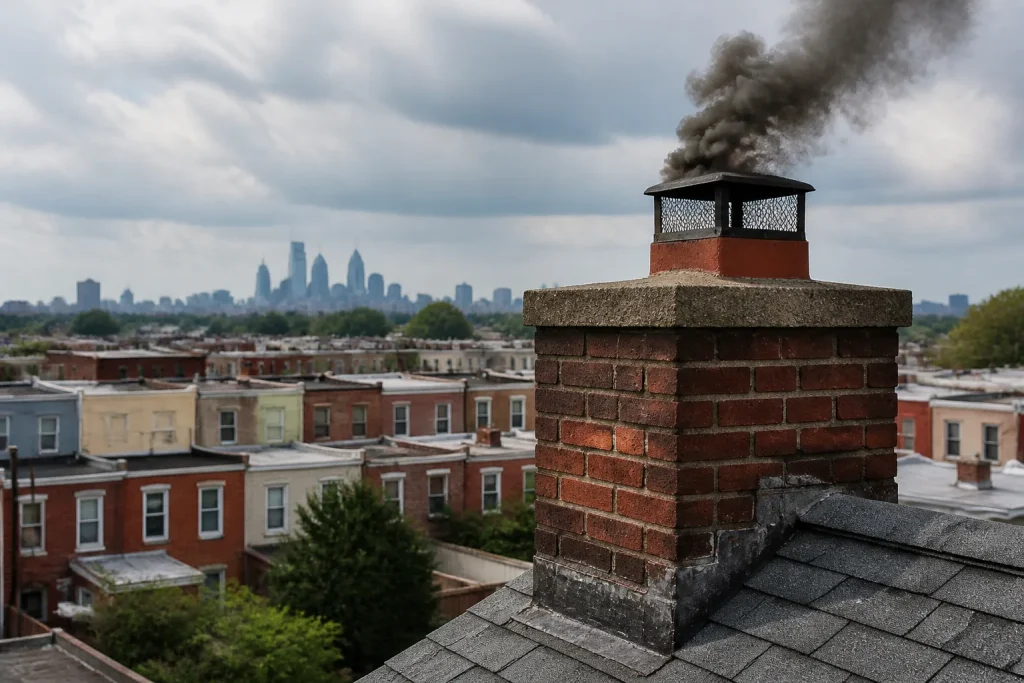
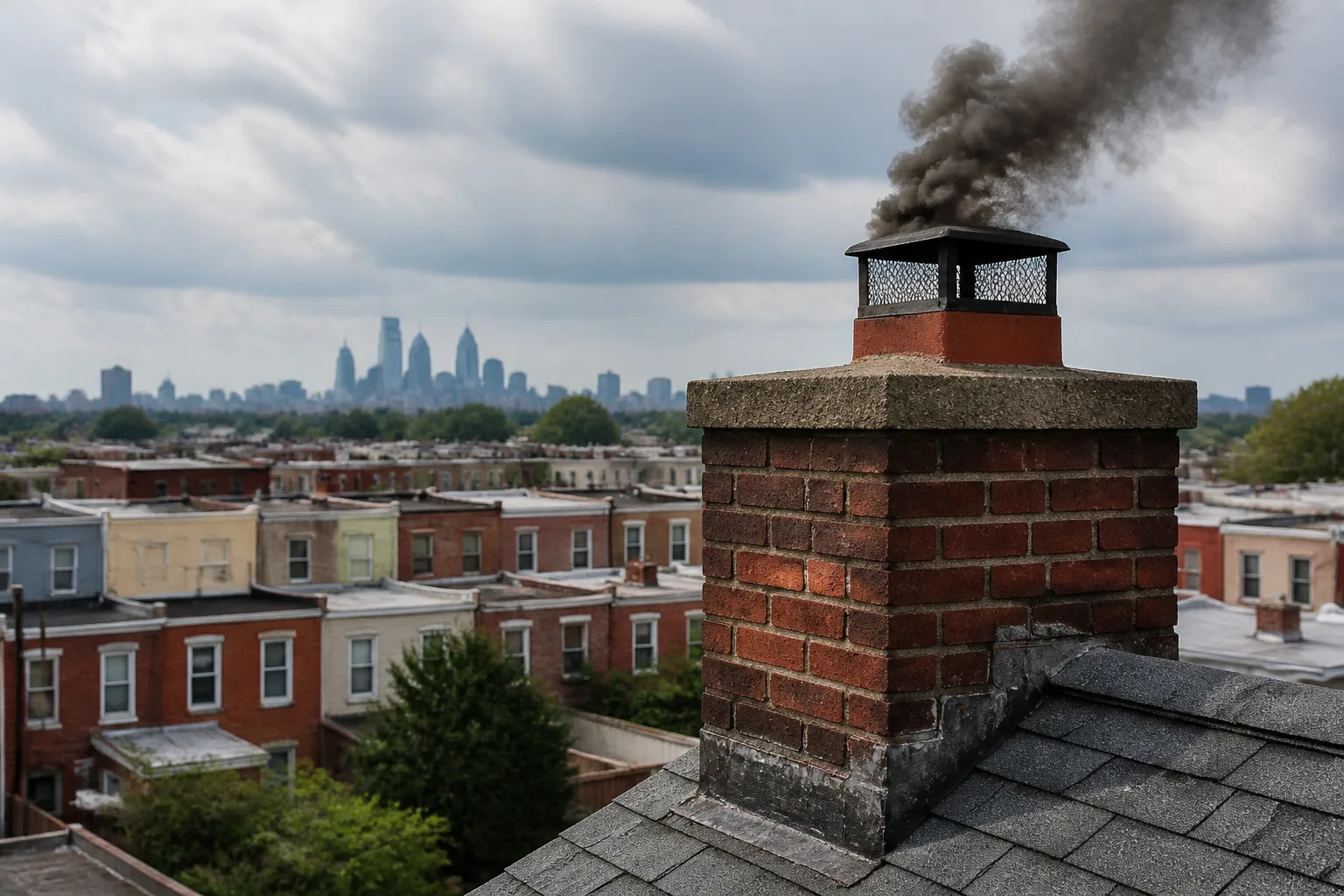
- Exterior signs: From outside, sparks or flames at the chimney cap confirm a fire. Heavy smoke rising slowly from the top is more consistent with a smoldering fire or a blockage.
Smoke intrusion alone still matters. Carbon monoxide has no smell and no color, and a blocked or cracked flue can let it into the house. If you smell smoke in a Northeast Philadelphia home with a gas appliance vented through the chimney, leave and call for help. The protocol for gas and oil appliances is the same as for a chimney fire: clear the house, then call.
What can an emergency chimney sweep actually assess safely?
An emergency sweep can remove fresh creosote, clear a blockage, and check the firebox and visible flue. It cannot safely certify a chimney after a fire. That requires a Level 2 inspection with a camera and, often, a Level 3 if structural damage is suspected.
What a sweep visit can typically do:
- Clear a blocked or partially blocked flue that’s causing smoke backup.
- Remove loose creosote and debris from the firebox and lower flue.
- Inspect the firebox, damper, and visible portions of the flue.
- Check the chimney cap and crown for obvious damage.
- Document what’s visible and recommend next steps.
What a sweep visit can’t do, at least not on a post-fire call: certify the liner is intact, confirm the flue hasn’t warped or separated at the joints, or clear the system for use again. Those calls belong to a full inspection. When a Northeast Philadelphia homeowner calls us about a suspected fire, we’re upfront about this. A sweep clears the symptoms; an inspection answers the safety question.
For the routine version of this work, see our chimney sweep service page. It covers what a standard cleaning involves and how to know when your chimney is due.
What should you tell a chimney specialist when you call?
Tell them what you saw, heard, and smelled, and tell them whether a fire was involved. That single piece of information changes what they bring and who they send. A sweep called for a routine cleaning arrives with brushes and a vacuum. A sweep called for a suspected fire arrives with inspection cameras, liner assessment tools, and a plan for the larger conversation.
Give them these details when you call:
- Whether a fire occurred, when, and whether the fire department came.
- What the fire department documented or told you.
- What you saw: flames, sparks, smoke, or nothing visible.
- What you heard and smelled.
- The age of the home and whether the liner has been replaced.
- Whether you have a wood-burning or gas appliance, or both.
The age of the home matters in Northeast Philadelphia, where a lot of the housing stock predates modern liner standards. Older flues may have unlined or partially deteriorated clay tile, and a specialist needs to know that before scheduling. If the liner is cracked, we may be recommending HeatShield resurfacing or a DuraFlex flexible stainless liner rather than a standard cleaning. Naming that when you call saves a second visit.
What do fire codes in Northeast Philadelphia require after a chimney fire?
After a chimney fire, documentation and a post-fire inspection are typically required before the fireplace goes back into use. Requirements vary by jurisdiction, so confirm specifics with the city’s fire marshal or building department rather than taking a neighbor’s word for it.
What usually needs to happen:
- The fire department’s incident report needs to be on file.
- A licensed inspector documents the chimney’s condition, often with photos and camera footage.
- Any damaged components are repaired or replaced before the fireplace is relit.
- The homeowner keeps the inspection record with the fire report for insurance purposes.
We tell every Northeast Philadelphia homeowner the same thing after a fire: don’t relight until the inspection says it’s safe, and keep the paper trail. Insurers ask for it if there’s a future claim. Fire marshals ask for it if there’s a future incident. And a rebuild, if it’s needed, goes more smoothly with a documented starting point.
If the inspection finds structural damage, that’s chimney repair territory. A cracked crown or weakened mortar joint is a repair, not a cleaning, and the two get scheduled differently.
When should you call a pro instead of waiting it out?
Call a pro whenever smoke, smell, or noise suggests something is wrong with the flue and you can’t see the problem yourself. That’s most of the time. The homeowner who can safely diagnose their own chimney from the living room is rare.
Call right away if you’re seeing:
- Smoke rolling back into the room when the fire is burning.
- A strong creosote smell that doesn’t clear when the fire dies.
- Visible cracks in the firebox or in the masonry above the fireplace.
- White staining or crumbling on the exterior chimney, which can point to moisture or liner problems.
- A sudden change in drafting, like a fire that used to burn well and now doesn’t.
If a fire occurred, call after 911. If it didn’t, a call to us is still the right move. Our technicians have up to 13 years of experience, and we use the trade brands you’ll see named in a complete chimney report: HeatShield for liner resurfacing, DuraFlex for flexible stainless retrofits, and Olympia Chimney, Gelco, Famco, and Copperfield for the caps, crowns, and components that finish the job. When the diagnosis calls for cap or crown work, that’s chimney cap & crown and it’s handled without bringing in a second contractor.
One thing we won’t do is tell you the chimney is dangerous when it isn’t. A lot of what we find can safely wait until the spring. If the camera shows the liner is intact and the creosote is within normal range, we’ll say so.
The Bottom Line
A chimney fire gets one sequence: close the damper, call 911, call a specialist. A smoke backup gets a different one: note the symptoms, clear the house if you smell gas or feel unwell, and call for an inspection. In either case, don’t relight until a full inspection clears the system.
If you’re in Northeast Philadelphia and need help, Chimney Sweep Northeast Philadelphia offers free estimates. Call (855) 658-4023. We answer 24/7. Fast dispatch from 7am to 7pm, Sunday through Friday. When the diagnosis is a routine cleaning, see our Chimney Sweep Northeast Philadelphia hub for the basics, including what a typical visit covers from the firebox to the crown.
Frequently Asked Questions
Close the damper, get everyone out of the house, and call 911. Don’t try to put it out yourself. A chimney fire can spread into framing and may already be out by the time the fire department arrives, which is exactly why a full post-fire inspection is required before the fireplace is used again. Call (855) 658-4023 for an exact quote on the inspection. Estimates are free.
No, not safely. A sweep can clear creosote and debris, but a post-fire safety clearance requires a Level 2 inspection with a camera to confirm the liner and flue joints survived intact. Need a sweep for a routine cleaning? Call (855) 658-4023 for an exact quote. Estimates are free.
Sound, smell, and heat tell the difference. A roaring or popping sound, a sharp creosote smell, and a hot chimney breast point to fire. Quiet smoke with a wood-burning smell points more often to a draft or blockage. When you can’t tell, treat it as a fire and call 911. Then call (855) 658-4023 for the post-fire inspection.
Tell them whether a fire occurred, what the fire department documented, what you saw, heard, and smelled, the age of the home, and whether the liner has ever been replaced. That information determines whether they arrive with brushes or with a camera and liner assessment gear. Call (855) 658-4023 for an exact quote. Estimates are free.
After a chimney fire, yes. Hidden cracks or warped liner joints can let heat and carbon monoxide into the house the next time you light a fire. If no fire occurred and the diagnosis is a routine cleaning, the call can often wait until the creosote buildup justifies it. Call (855) 658-4023 to book an inspection or a sweep. Estimates are free.
Written by the team at Chimney Sweep Northeast Philadelphia.
Need Chimney Cleaning Help?
Call Chimney Sweep Northeast Philadelphia - the local pro we connect you with is licensed and insured, with free written estimates in Northeast Philadelphia.
(855) 658-4023